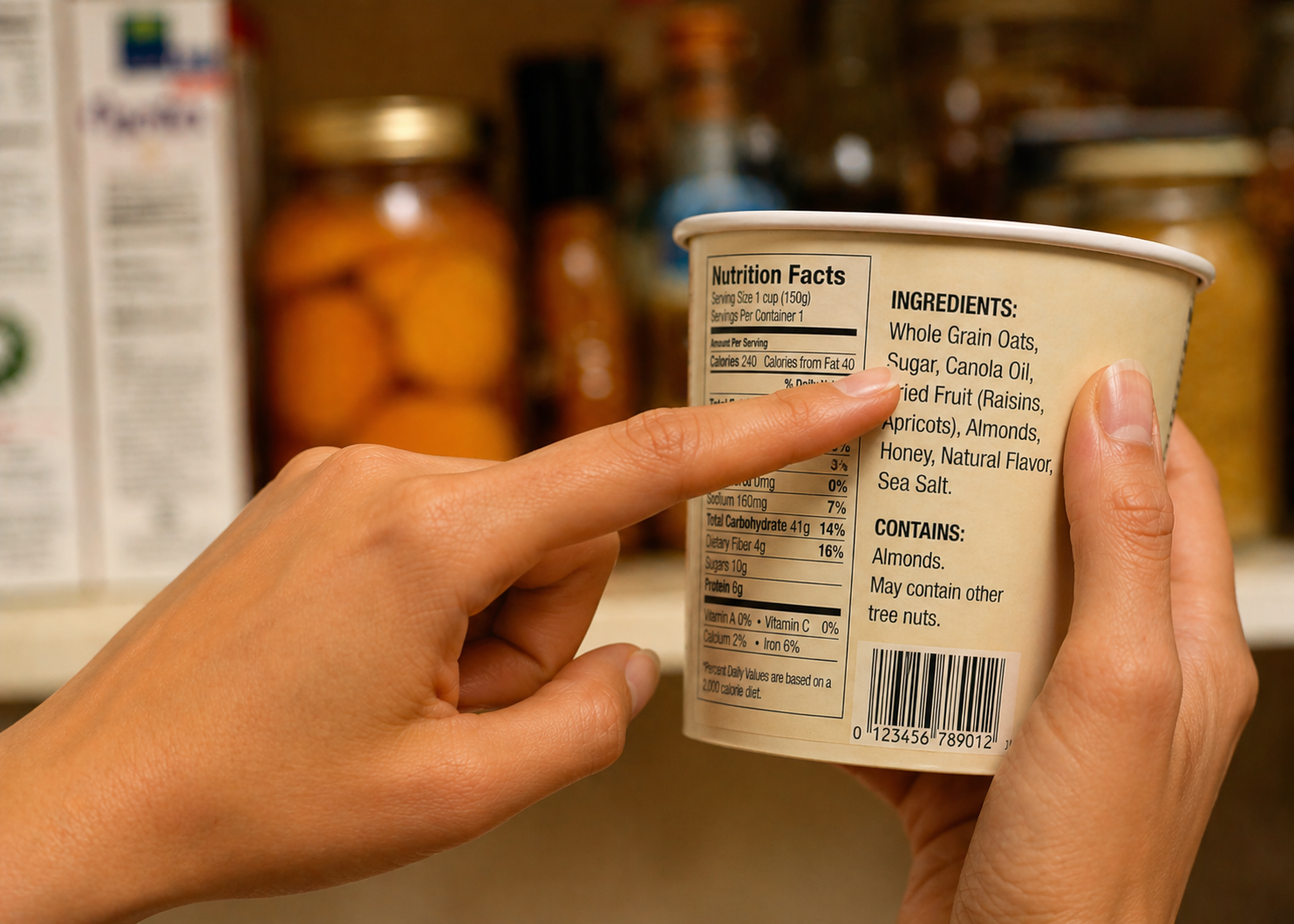
Most food labels are designed to look healthy at first glance, as food marketing is optimized to influence perception. The part that is strictly regulated is the ingredient list – which makes it much harder to manipulate. That’s why the ingredient list tells the real story. InSpoon can instantly analyze it for you, highlighting nutrients to limit like added sugar and sodium, as well as additives and overall processing level.
The good news: you don’t need to understand everything on the label.
You just need a fast system.
Here’s how to read any ingredient list in 10 seconds.
1. Check the first 3 ingredients
Ingredients are listed by weight. The first three usually make up most of the product.
Example:
“Whole grain oats, sugar, canola oil”
This is mostly oats + sugar + oil. Everything else is minor.
Rule:
Even if the front says “healthy” or “natural”, the core is defined here. If sugar (or any sweetener) is in top 3 → treat as a sweet product, no matter the front label.
2. Look for hidden sugars
Sugar rarely appears just as “sugar”. Brands split it into multiple names so it doesn’t appear first.
Common ones:
- sugar, cane sugar, brown sugar
- glucose, fructose, sucrose
- corn syrup, high fructose corn syrup
- maltose, dextrose
- honey, agave nectar, maple syrup
- fruit juice concentrate
Example:
“Whole grain oats, corn syrup, honey, brown sugar…”
Looks like 4 ingredients, but it’s basically sugar stacked multiple ways.
Rule:
Combine all sugars together, not individually.
3. Spot ultra-processed signals
You don’t need to know every additive – just patterns.
Watch for:
- long list (10+ ingredients)
- flavor enhancers (“natural flavors”, “artificial flavors”)
- emulsifiers (lecithin, mono- and diglycerides)
- stabilizers/thickeners (gums, carrageenan)
- preservatives (sorbate, benzoate, nitrites)
Example
If bread has 15 ingredients + multiple gums → it’s engineered, not basic bread.
Rule:
The more “functional” ingredients, the more processed the product.
The 10-second method
When you pick up a product:
- Read the first 3 ingredients
- Scan for sugar aliases
- Check list length and additives
That’s it.
Real example
Peanut butter (simple):
Peanuts, salt
Peanut butter (processed):
Peanuts, sugar, palm oil, mono- and diglycerides, natural flavors
Same product category – completely different quality.
If you don’t want to manually decode labels every time, InSpoon scan ingredient lists and highlight things like hidden sugars, additives, their nutrients and processing level automatically.
If you remember only 3 things:
- First 3 ingredients define the product
- Sugar hides under many names
- Longer lists usually mean more processing
That alone will help you make better choices in seconds.