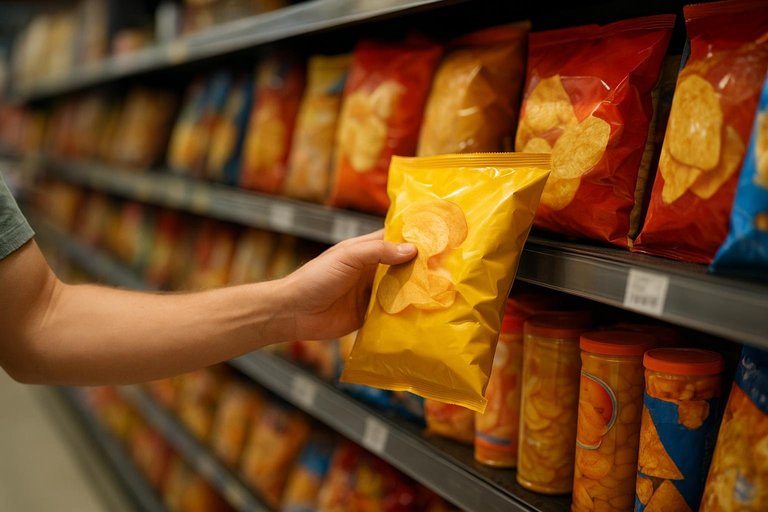
Have you ever opened a bag of chips intending to eat just a handful, only to realize you’ve finished the entire bag? Or found yourself craving soda, cookies, or fast food even when you weren’t physically hungry?

For some people, these experiences go beyond simple overeating.
An increasing body of research suggests that certain ultra-processed foods may trigger addictive-like behaviors in some individuals. While ultra-processed food addiction is not currently recognized as an official medical diagnosis, scientists are actively studying whether some highly processed foods affect the brain in ways that resemble addictive substances.
Here’s what current research says—and what it doesn’t.
What Are Ultra-Processed Foods?
Ultra-processed foods (UPFs) are industrially manufactured products made mostly from refined ingredients and additives rather than whole foods.
Examples include:
- Potato chips
- Candy
- Cookies
- Ice cream
- Sugary breakfast cereals
- Fast food
- Sweetened beverages
- Packaged pastries
These foods are often engineered to be:
- Highly palatable
- Convenient
- Inexpensive
- Shelf-stable
Many contain combinations of refined carbohydrates, added fats, salt, flavor enhancers, and sweeteners that are rarely found together in nature.
Can Food Really Be Addictive?
This remains one of the most debated questions in nutrition science.
Researchers are not suggesting that all foods are addictive.
Instead, much of the research focuses specifically on ultra-processed foods, particularly those high in refined carbohydrates and added fats.
Scientists have found that these foods can strongly activate the brain’s reward system, including dopamine pathways involved in motivation and reinforcement.
Some researchers argue that certain ultra-processed foods meet many of the scientific characteristics used to evaluate addictive substances, while others believe more evidence is needed before they should be classified that way.
What Is the Yale Food Addiction Scale?
Most research uses a questionnaire called the Yale Food Addiction Scale (YFAS).

Rather than measuring how much someone eats, it evaluates behaviors commonly associated with substance addiction, including:
- Strong cravings
- Repeated unsuccessful attempts to cut back
- Loss of control
- Continuing to eat despite negative consequences
- Spending excessive time obtaining or thinking about certain foods
- Withdrawal-like symptoms after reducing intake
The scale is widely used in research, but it is not the same as receiving a formal medical diagnosis.
How Common Is It?
Recent reviews estimate that approximately:
- 14% of adults
- 15% of children and adolescents
meet research criteria for ultra-processed food addiction using the Yale Food Addiction Scale. Rates are higher among people living with obesity.
A 2025 University of Michigan study focusing on adults aged 50 to 80 found notable generational differences.
Among participants:
- Around 21% of women aged 50–64
- Around 10% of men aged 50–64
met research criteria for ultra-processed food addiction.
Rates were lower among adults aged 65 to 80. The researchers also found that people reporting poorer physical or mental health, social isolation, or perceiving themselves as overweight were more likely to meet these research criteria.
Importantly, this was an observational study, meaning it identified associations rather than proving cause and effect.
Why Might Ultra-Processed Foods Be Different?
Researchers believe several factors may contribute.
Many ultra-processed foods combine:
- Refined carbohydrates
- Added fats
- Salt
- Artificial flavors
- Texture enhancers
into combinations designed to maximize taste and repeat consumption.
Some studies suggest these foods:
– Produce strong reward responses.
– Encourage repeated eating.
– Increase cravings.
– Are rapidly digested, leading to quick changes in blood sugar and hunger.
Scientists are also studying changes involving the brain-gut-microbiome axis, including alterations in reward signaling, hunger hormones, and gut bacteria among people who show signs of addictive-like eating. Much of this work is still developing, and researchers continue to investigate whether these biological changes are causes, consequences, or both.
Can People Experience Withdrawal?
Some people report symptoms after significantly reducing ultra-processed foods, including:
- Irritability
- Headaches
- Fatigue
- Mood changes
- Strong cravings
Animal studies have demonstrated withdrawal-like responses after removing highly processed foods or sugar from the diet.
Human studies have found similar self-reported experiences, often peaking within several days after reducing ultra-processed foods. However, these findings are still preliminary, and researchers note that more rigorous prospective studies are needed to confirm whether this represents a true withdrawal syndrome comparable to substance withdrawal.
Does This Mean Everyone Is Addicted?
No.
Most people enjoy ultra-processed foods occasionally without meeting research criteria for addiction.
Like alcohol or gambling, vulnerability appears to differ between individuals.
Factors that may influence susceptibility include:
- Genetics
- Stress
- Food environment
- Mental health
- Early-life exposure
- Access to nutritious foods
Researchers are also investigating whether childhood exposure to highly processed foods may influence later eating behaviors.
What Can You Do If You Feel Out of Control?
If you frequently feel unable to control your intake of certain foods, you’re not alone.
Helpful strategies may include:
- Eating regular balanced meals.
- Including more protein and fiber.
- Keeping tempting foods out of immediate reach if they trigger overeating.
- Managing stress through sleep, exercise, or relaxation techniques.
- Seeking guidance from a registered dietitian or healthcare professional if eating behaviors cause distress.
Unlike dieting based on willpower alone, addressing eating habits often requires looking at the broader environment and daily routines.
How InSpoon Can Help
Many ultra-processed foods look healthy because they’re labeled as “high protein,” “whole grain,” or “low fat.” Marketing claims don’t always tell the full story.
The InSpoon app lets you scan packaged foods to quickly review ingredients, nutrition information, food additives, and an easy-to-understand health score, helping you compare products and make more informed choices.

Download InSpoon:
Frequently Asked Questions
Is ultra-processed food addiction officially recognized?
No. It is not currently recognized as a formal diagnosis in the *Diagnostic and Statistical Manual of Mental Disorders (DSM-5)*. However, it is an active area of scientific research.
Are all processed foods addictive?
No. Processing exists on a spectrum. Many minimally processed foods—such as frozen vegetables, canned beans, plain yogurt, or whole-grain bread—can be part of a healthy diet. Research focuses specifically on certain ultra-processed foods.
Does craving junk food mean I’m addicted?
Not necessarily. Occasional cravings are normal. Research definitions of ultra-processed food addiction involve persistent patterns such as loss of control, repeated unsuccessful attempts to cut back, and continued consumption despite negative consequences.
Should I completely avoid ultra-processed foods?
Not necessarily. Many nutrition experts recommend focusing on an overall eating pattern rich in whole and minimally processed foods rather than striving for perfection.
Reducing reliance on ultra-processed foods may benefit health, but occasional consumption can fit into a balanced diet for many people.
Final Thoughts
Research into ultra-processed food addiction has grown rapidly over the past decade. While the concept remains scientifically debated, studies suggest that some highly processed foods may trigger addictive-like behaviors in a subset of people.
What is already well established is that diets high in ultra-processed foods are associated with poorer health outcomes. Choosing more whole and minimally processed foods—and becoming aware of how certain foods affect your own eating habits—can be an important step toward long-term health.
As research continues, scientists hope to better understand who is most vulnerable, why these foods affect people differently, and which approaches are most effective for helping those who struggle with compulsive eating.